Five hours may sound excessive for sewing thread. But once stitching becomes part of the visible design, “close enough” can be the difference between a bag that looks carefully developed and one that simply looks assembled.
The Leather Colors Were the Difficult Part
This particular project was not using straightforward black, dark brown, or tan.
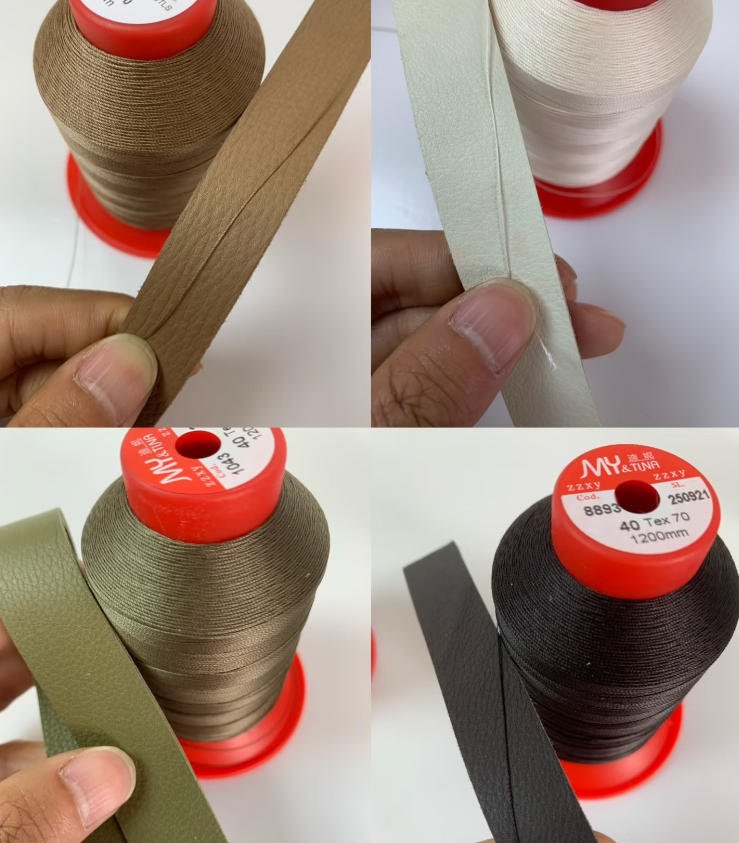
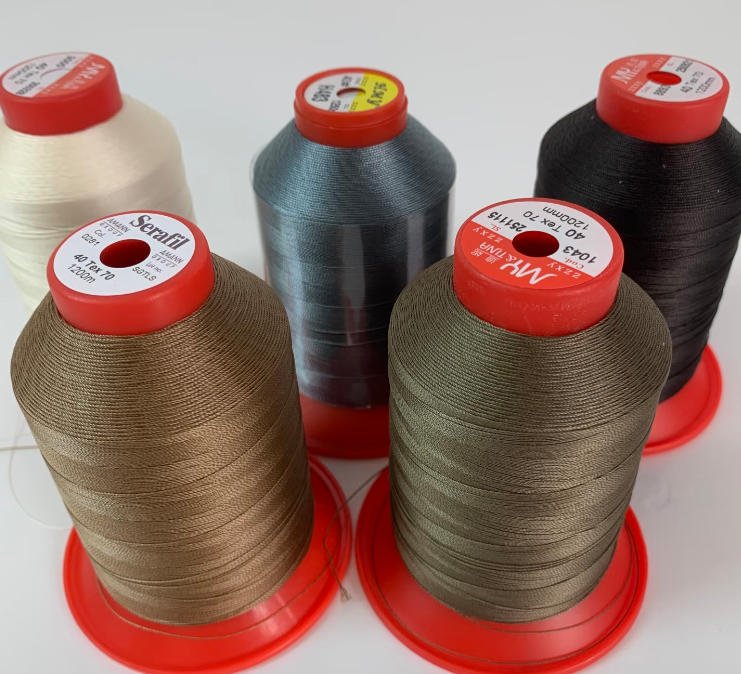
The leather colors sat somewhere in between: muted brown, olive, grey, off-white, and other low-saturation tones that can change noticeably depending on the light around them.
Finding a thread that is broadly “brown” or “green” is easy.
Finding the brown or green that sits naturally next to a specific leather is much more difficult.
A thread can look correct when it is on the cone, then appear too warm, too grey, too yellow, or too dark once it is placed directly beside the leather.
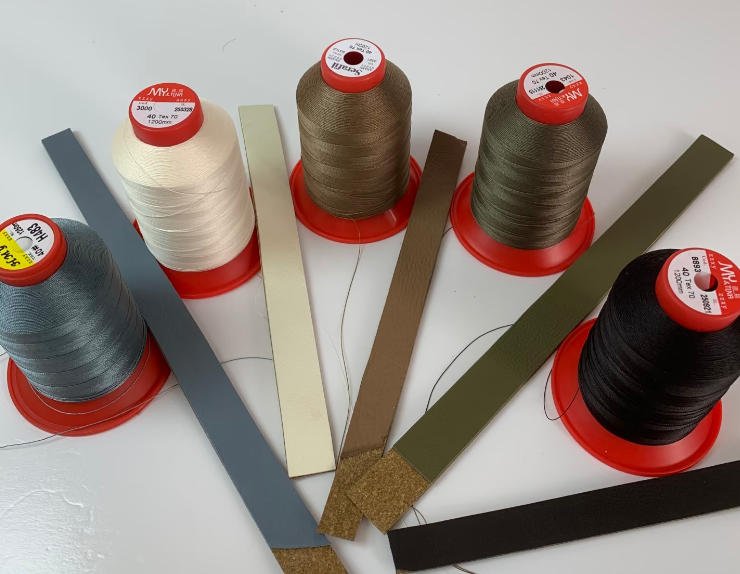
That is why our sourcing team compared the actual thread and leather together instead of choosing a color from a photo or screen.
Why Serafil?
For this project, one of the sewing threads we were evaluating was AMANN Serafil.
Serafil is a continuous-filament polyester sewing thread commonly used in applications such as leather goods, bags, footwear, belts, luggage, and other products where both stitch appearance and seam performance matter.
What matters to us is not simply the brand name on the cone.
The thread still has to work with the leather, the needle, the stitch length, the number of material layers, and the construction of the product.
For visible stitching on leather goods, the surface appearance of the thread also matters. Some threads produce a flatter or more matte-looking seam, while others give the stitching more definition and a subtle sheen.
Why Did It Take More Than Five Hours?
Because we were not looking for one general color.
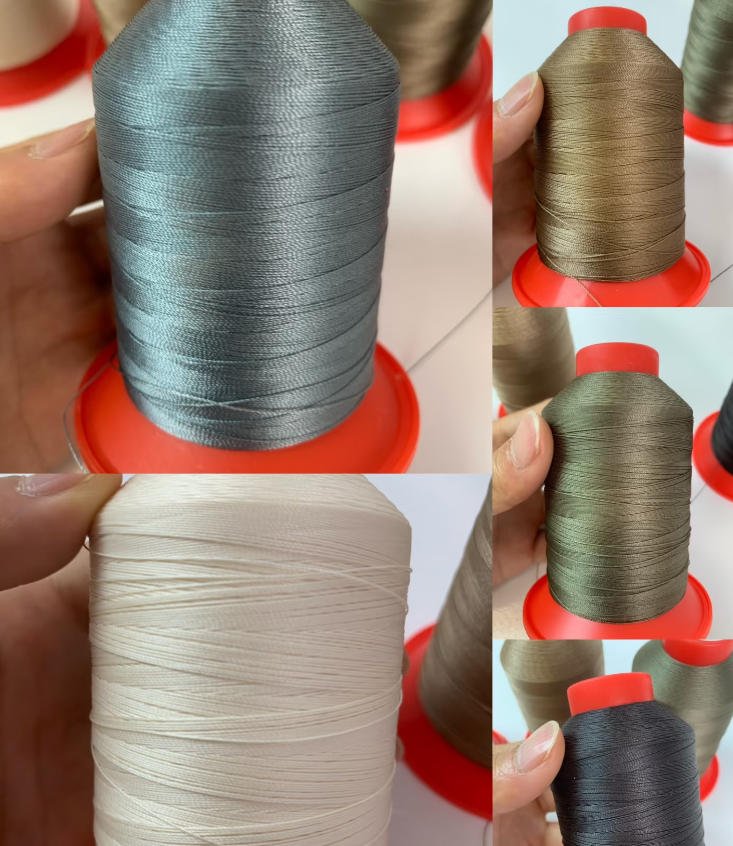
We were comparing several shades against several leather colors.
The difference between two thread codes may seem minor when the cones are sitting next to each other. Once the thread is stitched into leather, however, that small difference can become much more obvious.
For this project, the intention was not to create high-contrast stitching.
The thread needed to sit quietly with the leather and support the overall color direction of the bag.
So the team went supplier to supplier, compared different shades, placed the thread directly against the leather, moved it under different light, and checked it again.
Some colors were close.
Close was not enough.
Matching the Color Is Only the First Step
Once we find the closest thread color, the work is not finished.
The thread still needs to be tested on the leather.
A thread that looks perfectly matched while sitting beside a leather strip may look different once it forms an actual seam.
Stitching introduces tension, spacing, shadows, surface reflection, and multiple passes of thread through the material.
For that reason, the final sewing specification has to consider:
- Thread color and intended contrast
- Thread ticket size
- Leather thickness
- Number of layers being stitched
- Needle size
- Stitch length or SPI
- Structural or decorative seam requirements
- Thread tension
- Final stitch appearance
- Repeatability during bulk production
In other words, we do not confirm a sewing thread based on color alone.
Sometimes We Match. Sometimes We Intentionally Contrast.
Not every handbag needs perfectly tone-on-tone stitching.
Sometimes the designer wants the seam to disappear into the leather as much as possible.
In other projects, the stitching may intentionally be slightly lighter, darker, warmer, or cooler so that it becomes part of the visual design.
The correct choice depends on the tech pack, reference sample, and the look the client is trying to achieve.
Our job is not simply to choose the closest number on a color card.
It is to prepare the options that make sense and show how those options actually behave on the selected leather.
From Thread Selection to Sewing Test
After the closest colors are shortlisted, we move into an actual sewing test.
The selected thread is stitched onto the project leather or onto a comparable material construction.
This gives us a much better way to judge the final seam than simply holding a cone beside the leather.
We can check whether the color still looks right after stitching, whether the thread size suits the leather thickness, and whether the stitch definition matches the design.
If necessary, we can still adjust the thread shade, ticket size, needle, stitch length, or machine tension before the sample specification is approved.
Why This Small Detail Matters in Bulk Production
A good sample is not enough if the same result cannot be repeated across the production order.
Once the client approves the leather, thread color, thread size, and sewing appearance, those details become part of the production specification.
The sewing team then needs to follow the approved combination consistently throughout bulk production.
This matters especially on visible seams around handles, straps, front panels, gussets, pockets, zipper openings, and edge constructions.
A slight change in thread shade or thickness may not seem important when viewed separately, but it can become obvious once several finished bags are placed side by side.
Five Hours for Something Most Customers Will Never See
The person who eventually buys the finished bag will probably never know that someone spent five hours looking for the thread.
They will not know how many shades were rejected or how many suppliers were checked.
But they can still see the result.
When the leather, stitching, edge paint, zipper, lining, and hardware all feel as though they belong together, the product looks more resolved.
That is the part of bag development that rarely appears on a tech pack.
After 19 years of working with custom bag development, we have developed a simple habit:
if we spend time choosing the right leather, we should spend the same care choosing what is used to sew it.