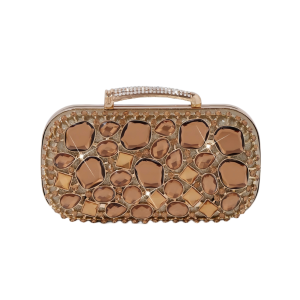
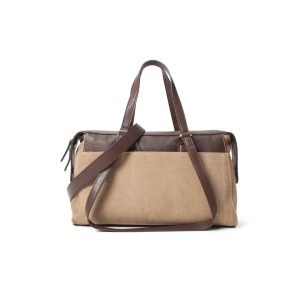
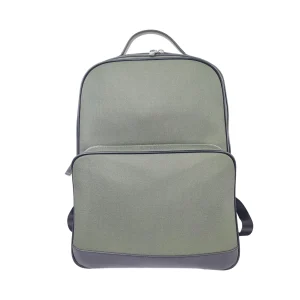
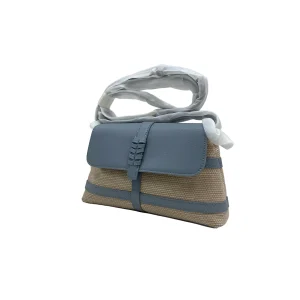
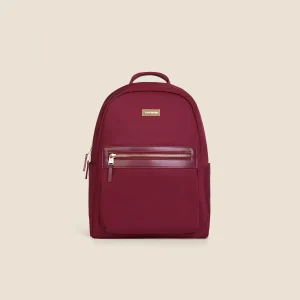
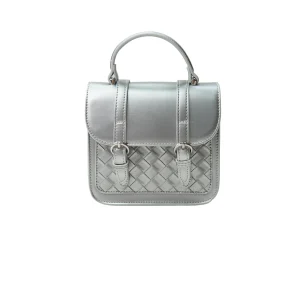
Hermès bag closures show that access is not a small hardware decision; it is the first physical conversation between a customer and a handbag. Current listings for the Charnière To Go, Hermès Geta slim, Glenan To Go, Zipengo, Onbody Quart de Tour, and Double Longe place hinges, magnets, tabs, zippers, snaps, and hooks at the center of how each product is carried and used. For private-label and OEM teams, the useful factory perspective is to engineer an original opening sequence around security, speed, hand movement, and load instead of treating the closure as decoration.

The 2026 context for Hermès bag closures
The broader collection language makes hardware interaction timely. Vogue’s Fall 2026 Hermès runway review framed the season through romance and utility, noting removable shearling collars and leather coats with zippers spiraling around the body. Vogue’s Spring 2027 collection coverage described a lighter idea of air and observed that leather was concentrated mainly in accessories and accents. These apparel details do not prove how a handbag is built, but they establish a current design context in which movement, modularity, and touch matter.
Hermès bag closures translate those themes into small, repeatable actions. A hinge creates a deliberate opening arc. A magnetic clasp can secure contents while also affecting strap adjustment and base contact. A zipper sets an access path and gives the pull tab a tactile role. A snap hook can close the body and reorganize how the bag is carried. Across Hermès bag closures, each system asks the customer to learn a different gesture.
That is why a closure report is more useful than another silhouette ranking. The public product pages provide observable information about mechanisms, pockets, straps, dimensions, and prices. They do not disclose confidential manufacturing methods, tolerances, or suppliers. The analysis can therefore separate public customer experience from independent engineering choices that another brand would need to develop for itself.
Five actions define the closure experience
Hermès bag closures can be compared through five actions rather than through appearance alone. The sequence begins before the hardware moves and continues after the bag is closed. A closure that looks precise but interrupts normal use is not fully resolved.
| Customer action | Design question | Evidence to validate |
|---|---|---|
| Approach | Can the hand find the operating point without looking? | Reach path, visual cue, left- and right-hand use |
| Open | How much force, travel, and clearance are required? | Opening angle, pull distance, friction, obstacle clearance |
| Retrieve | Does the opening expose the intended pocket or compartment? | Phone and card access, visibility, lining interference |
| Secure | How does the user know the closure is fully engaged? | Sound, tactile feedback, alignment, retention under load |
| Convert | Does the mechanism also change carry or resting posture? | Strap adjustment, hook position, base stability, loose parts |
This framework reveals why Hermès bag closures deserve product-level analysis. The mechanism is never isolated from the opening edge, lining, pockets, strap, and contents. When one component changes, the user’s sequence may change with it. A disciplined closure brief therefore begins with the action and works backward to geometry, material, hardware, and assembly.
Charnière To Go turns a hinge into the opening architecture
The official Charnière To Go pouch page describes a Box calfskin pouch with a Charnière closure, one large main compartment, three card slots, and a removable strap. It can be carried by hand or over the shoulder, measures 8 by 4.3 by 1.4 inches, and was listed at USD 8,400 when reviewed on October 15, 2026.
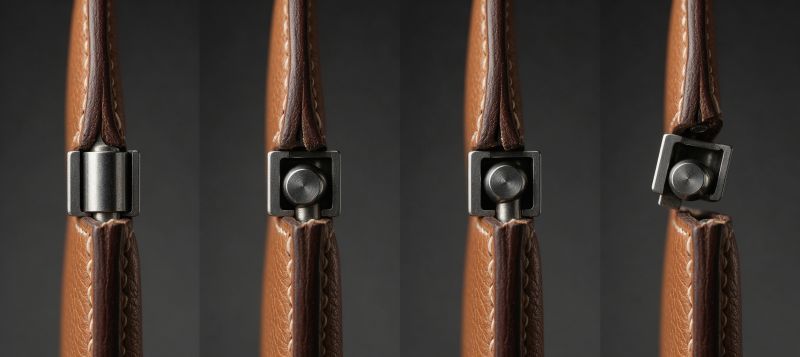
Among current Hermès bag closures, this is the clearest example of mechanism becoming architecture. A hinge does more than connect two edges. It determines where the body pivots, how far the opening can travel, whether the contents remain protected during movement, and how the product feels when held open. The user experiences the hardware through motion rather than as a static emblem.
The card slots and main compartment are part of that choreography. If the hinge opens to a controlled angle, the internal layout must place frequently used items within the visible zone. The removable strap then adds a second state: the pouch may be operated in the hand or while suspended. Hermès bag closures demonstrate here that the access path and carry mode cannot be designed separately. This integration gives Hermès bag closures a complete customer sequence.
For an original product, a hinged opening requires a fresh geometry and a full mechanical specification. Development teams would need to define pivot placement, opening angle, stop behavior, edge clearance, cycle target, pinch protection, fastener retention, leather compression, and service access. They must not reproduce a protected Hermès mechanism or recognizable external expression. The transferable lesson is the integration of movement and organization.
Geta slim assigns three jobs to one magnetic clasp
The Hermès Geta slim product page lists Evercolor calfskin, a magnetic closure, a main compartment, and two interior flapped pockets, one divided into two parts. It also describes an adjustable canvas shoulder strap and states that the magnetic clasp works as a sliding mechanism for the strap and as bottom studs before folding down to secure the contents. The observed price was USD 7,650.
Hermès bag closures are most instructive when one mechanism changes more than the open-or-closed state. In the Geta slim description, the clasp participates in security, strap adjustment, and how the bag meets a surface. That creates efficiency at the concept level, but it also raises the engineering stakes because one part influences several customer experiences.
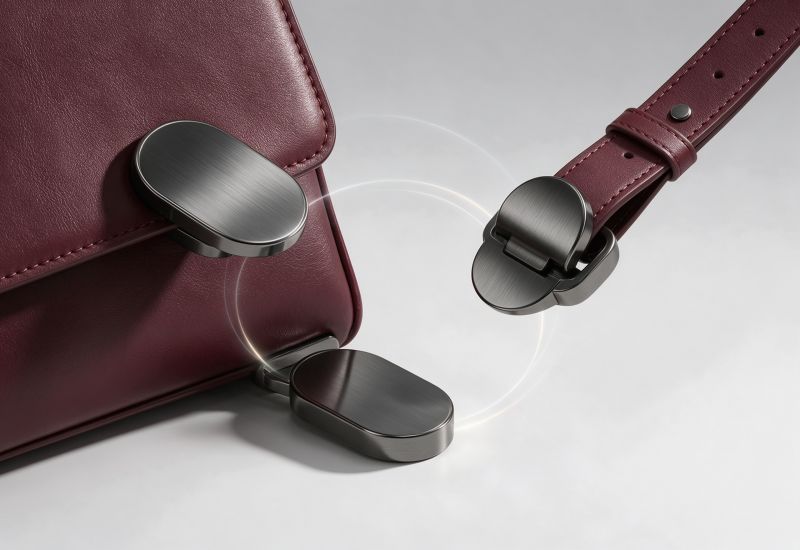
A multifunction component can fail in subtle ways. Strong magnetic attraction may improve engagement but make one-handed opening uncomfortable. A sliding strap interface may introduce wear near the closure. Contact with a tabletop may expose the component to impact or abrasion. Hermès bag closures make the customer benefit visible; an independent design team must still convert its own idea into measurable thresholds and independent geometry.
The internal flapped pockets reinforce the sequence. After the clasp releases, the user encounters divided storage rather than one undifferentiated cavity. The product page therefore connects external security with internal control across Hermès bag closures. For another brand, the relevant question is whether the closure reveals the most important storage zone in the fewest natural movements.
Glenan and Zipengo offer two speeds of access
Two To Go pouches show how Hermès bag closures can share a marine-linked vocabulary while producing different access experiences. The products should not be treated as interchangeable simply because both can be carried by hand or on a removable strap.
Glenan uses a tab-led gesture
The Glenan To Go pouch listing describes a Swift calfskin clutch with a leather tab and Chaine d’Ancre closure. Its strap is adjustable and removable, allowing hand, shoulder, or crossbody carry. The observed price was USD 2,725.
The tab gives the hand a soft operating surface before it encounters the closure. That can make the action visually legible and reduce direct handling of polished metal. Within Hermès bag closures, Glenan represents a composed, front-facing ritual: approach the tab, disengage the closure, open the body, and restore the tab to its secure position.
Zipengo prioritizes a continuous zipper path
The Zipengo Chaine d’Ancre To Go pouch page describes printed Swift calfskin, a zip closure with Chaine d’Ancre pull tab, goatskin lining, and a removable strap. It states that the pouch holds two smartphones and six cards, and it showed USD 3,925 on the review date.
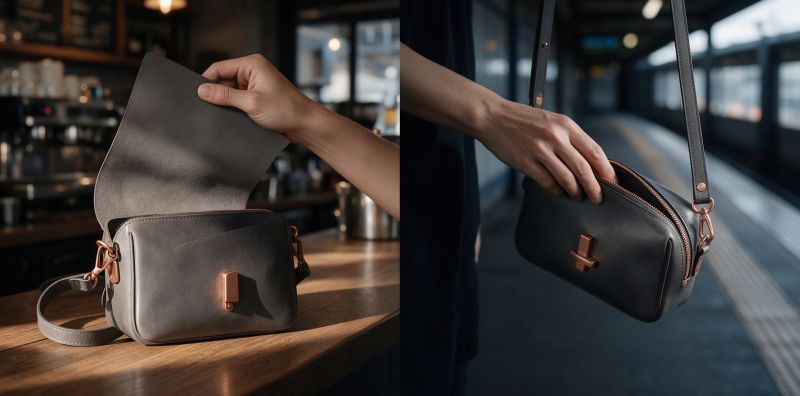
Zipengo gives Hermès bag closures a different rhythm. The user follows a linear path, and the pull tab communicates where that path begins. The stated capacity also makes the access claim testable: two phones and six cards must remain retrievable after the zipper is installed and the pouch is loaded. Capacity therefore changes how Hermès bag closures should be evaluated.
For product planning, the comparison is valuable because it links mechanism to occasion. A tab closure can create a deliberate front gesture, while a zipper can support continuous edge security and direct retrieval. An original collection might use different mechanisms for different customer tasks, but each one should have its own visual cue, force range, and pocket relationship.
Onbody Quart de Tour keeps the zipper visually quiet
The Onbody Quart de Tour product page presents a Swift calfskin bag with a zip closure, two interior pockets, Swift calfskin lining, and an adjustable shoulder strap with a 15-millimeter Etrivière buckle. It can be worn on the shoulder or across the body, measures 7.9 by 4.9 by 2.4 inches, and was listed at USD 5,700.
Not all Hermès bag closures are designed to dominate the product story. Here, the zipper supplies familiar security while the interior pockets and adjustable strap support everyday use. The official description also mentions base studs inspired by a Haut à Courroies 40 bag, but the access sequence remains concise: unzip, reach one of two pockets, close, and return the bag to the body.
A quiet closure still needs detailed validation. The zipper gauge affects bending at the opening. The track shape affects how widely the bag can spread. Pull placement affects use on either shoulder. Interior pocket edges can catch the hand or contents if they sit too close to the path. Hermès bag closures remind sourcing teams that familiar hardware is not automatically simple hardware. Even quiet Hermès bag closures depend on exact relationships.
For an original crossbody product, the development brief should state where the zipper begins when worn, whether the user can operate it one-handed, which pocket appears first, and how the strap angle changes opening tension. Those decisions are more defensible than asking a factory for a visually similar luxury reference.
Double Longe joins closure and carry conversion
The Double Longe product page describes a Togo and Swift calfskin bag with a snap closure, a maxi snap hook that enables short or long carry, an XL ring, and a sheathed equestrian-style turn-lock element. It can be carried by hand or on the shoulder and was listed at USD 7,100.
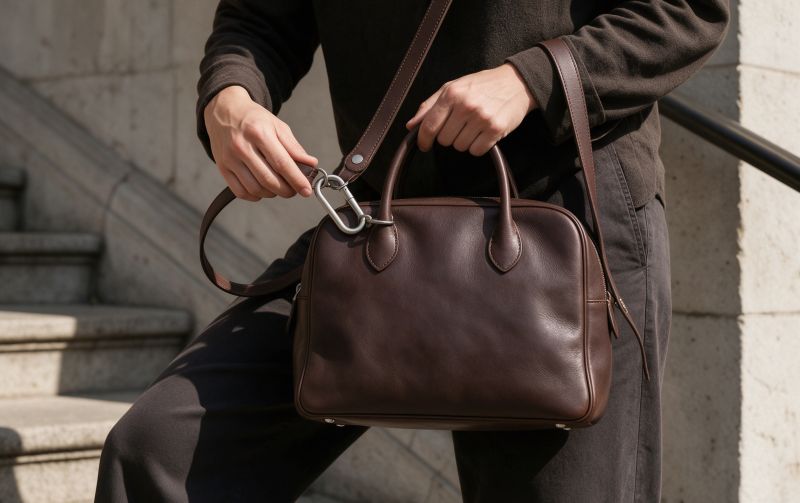
Among Hermès bag closures, Double Longe makes the strongest connection between fastening and posture. The snap closes the body, while the larger hook helps change the carry length. The system gives the customer more than a detachable strap added after the fact; the hardware vocabulary organizes the product’s states.
This kind of integration needs state-by-state testing. In short carry, unused length must not interfere with the opening. In long carry, the hook should remain oriented under load and away from the body. During conversion, the user needs a clear path that does not require placing the bag on a clean surface. Hermès bag closures make the benefit easy to describe, but an independent mechanism must be engineered around its own load path and safety margin.
Retail demonstration also matters for Hermès bag closures. A product page or sales associate should show the transition, not merely state that two carry modes exist. A still image can document each posture, while a short motion sequence can demonstrate the hook action and final security. The customer should understand the difference before purchase.
What the current price spread tells hardware buyers
The observed prices for these Hermès bag closures range from USD 2,725 for Glenan To Go and USD 3,925 for Zipengo to USD 5,700 for Onbody, USD 7,100 for Double Longe, USD 7,650 for Geta slim, and USD 8,400 for Charnière To Go. Prices and availability can change, and the figures do not isolate the value of hardware from leather, labor, design, brand, or retail context.
Even with that limitation, the spread helps buyers see that closure complexity is not a linear price formula. A familiar zipper may appear on a higher-priced leather bag, while a distinctive tab mechanism may sit lower in the observed set. Product role, material, internal organization, carry conversion, and overall execution operate together. Hermès bag closures should therefore be studied as part of complete products, not reduced to hardware cost.
For original range planning, the buyer should allocate development resources according to interaction risk. A new hinge or multifunction magnetic component may require more prototyping, cycling, tooling, and repair planning than a proven zipper installation. A convertible hook system may require more load and misuse testing. Spending should follow the mechanism’s responsibilities, not its visual size.
A private-label closure brief should start with behavior
The responsible B2B lesson from Hermès bag closures is to specify the user’s sequence before selecting a catalog component. This keeps the discussion focused on original function and prevents a protected luxury mechanism from becoming the brief.
Define the customer state
Record whether the bag is standing, suspended, worn crossbody, held in one hand, or moving when access occurs. State what the other hand is doing and which item the customer retrieves most often. A custom handbag brief becomes clearer when the closure is tied to a real posture.
Set measurable interaction targets
Specify opening force, closing confirmation, clearance, travel, one-hand operation, cycle target, load, and expected environmental exposure. If a magnet is proposed, document attraction and interference risks. If a hinge is proposed, document the arc and stop. If a zipper is proposed, define track shape and pull orientation.
Map closure dependencies
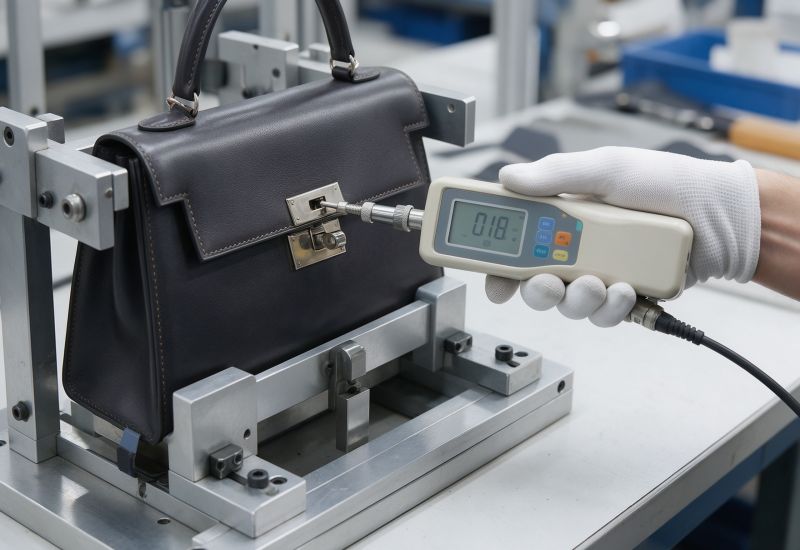
List every component affected by the mechanism: reinforcement, lining, pockets, straps, base, edge finish, and packaging. During the custom handbag sampling process, test the fully assembled bag because isolated hardware samples cannot reveal every conflict.
Plan verification and service access
Choose checkpoints for alignment, retention, finish, noise, cycling, and loaded use. Decide whether the component can be adjusted or replaced without damaging the body. Our luxury handbag OEM development service can review buyer-owned mechanisms and test plans for original products; it does not reproduce protected brand hardware.
Make the opening action belong to the new brand
Hermès bag closures provide a public study in varied customer interaction: Charnière makes the hinge architectural, Geta slim combines several roles in one clasp, Glenan uses a tab-led ritual, Zipengo follows a zipper path, Onbody keeps access quiet, and Double Longe links closure with carry conversion. The common lesson is not a particular component. It is the discipline of connecting hardware to the entire use sequence.
An independent brand should author that sequence from the ground up. The operating gesture, visible geometry, attachment, sound, finish, strap relationship, pocket map, and service plan should form a new combination owned by the project. Protected Hermès marks, proprietary mechanisms, recognizable hardware, and signature product expressions remain outside the development brief.
To review an original closure concept, send your handbag hardware inquiry with the intended customer action, drawings, mechanism ownership, load, target force, carry states, materials, and test expectations. The discussion can then focus on a differentiated closure system that works in the complete bag.
Independent disclaimer: This article is an independent educational analysis. It is not affiliated with Hermès. We do not produce counterfeit or replica goods, and we do not reproduce protected logos, trademarks, patterns, proprietary designs, hardware, silhouettes, or brand-identifying elements.