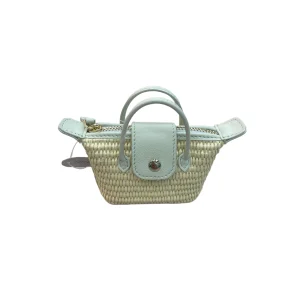
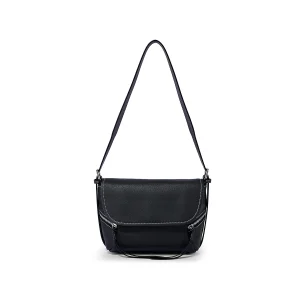
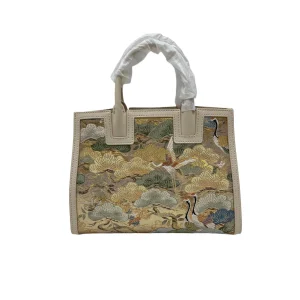
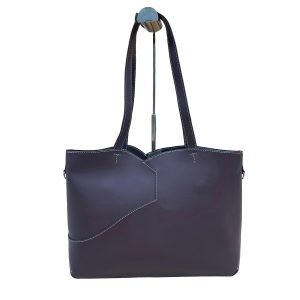
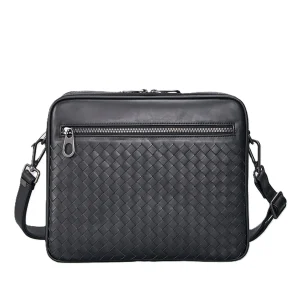
Handles flex. Flaps open and close. Corners rub against clothing and surfaces.
Straps are bent repeatedly during daily use.
If the edge finishing is poorly built, this is where cracks, uneven surfaces, roughness or separation can quickly affect the appearance of the entire bag.
This is why we treat edge paint as part of the bag construction rather than as a final cosmetic step.
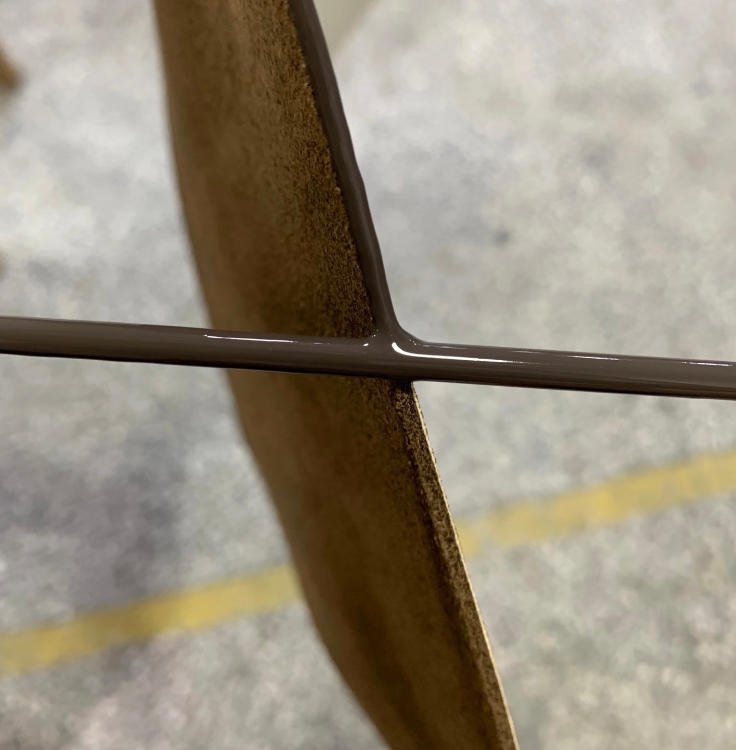
A Good Edge Is More Than a Line of Color
At first glance, edge paint looks simple.
A leather edge is prepared, color is applied, the coating dries, and the part moves into assembly.
In practice, the result depends on much more than the color itself.
The leather thickness, cut quality, fiber structure, flexibility of the component, preparation method, coating build, drying condition and sanding between stages can all influence the finished edge.
The same edge paint can produce very different results when these variables change.
This is why we normally evaluate the complete edge-finishing system rather than judging a product only by the brand name on the bottle.
Why Fenice Is One of Our Preferred Edge-Finishing Systems
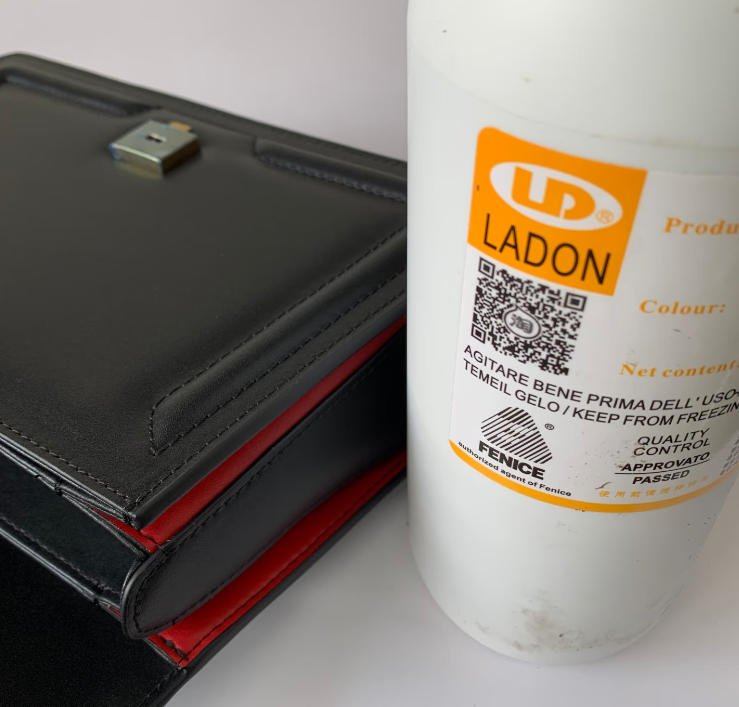
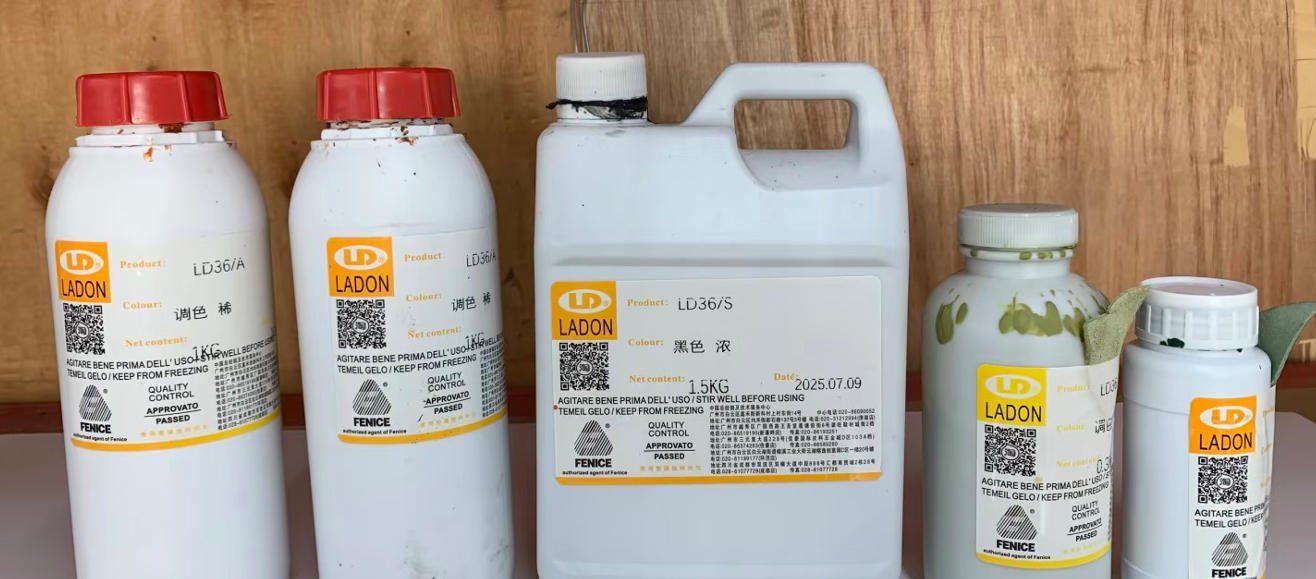
For premium leather projects, we often work with edge-finishing products from Fenice.
What matters to us is not simply that Fenice is a recognized leather-finishing supplier.
The more important point is that edge finishing can be treated as a system rather than as a single layer of color.
Depending on the leather and construction, the process may involve edge preparation, sealing or filling, adhesion support, color layers and final finishing.
That gives our development team more control when the edge needs to be adjusted for different leather types, thicknesses or performance requirements.
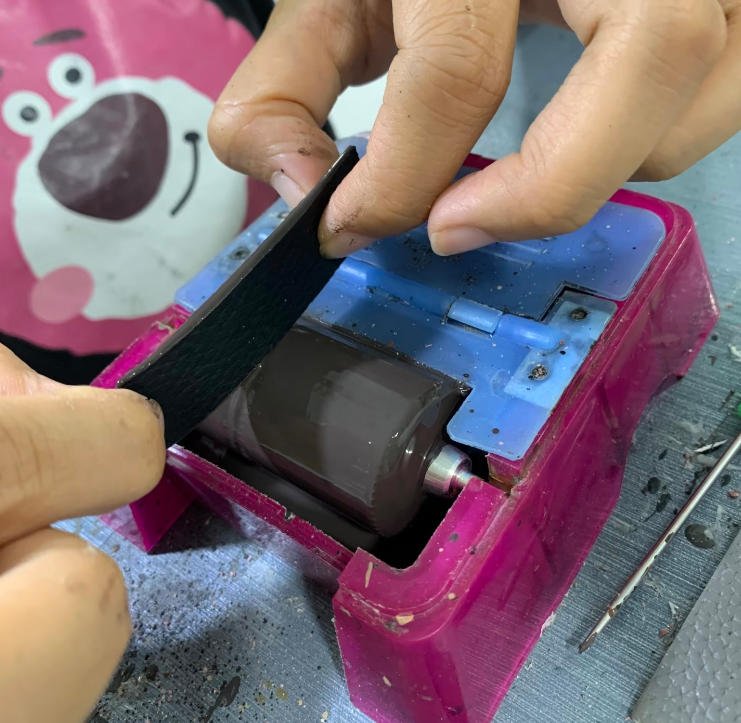
What We Actually Check Before Approving an Edge
A clean-looking sample is only the beginning.
Before an edge specification is approved for production, we look at several details together.
| Control Point | What We Look For | Why It Matters |
|---|---|---|
| Edge Preparation | Clean cutting, controlled fiber surface and an even base before coating. | Irregular preparation can remain visible even after several layers of paint. |
| Surface Smoothness | An even surface without excessive ridges, pits or heavy buildup. | The edge should look refined while preserving the intended shape of the component. |
| Color | Correct tone, saturation and relationship with the leather and lining. | Edge paint can either disappear into the design or become a deliberate visual accent. |
| Flexibility | The finished edge is checked on parts that will bend or flex during use. | Handles, straps and flaps behave differently from rigid decorative panels. |
| Coverage | Consistent color and coating around straight sections, curves and corners. | Corners and tight curves often reveal weaknesses that are less visible on straight edges. |
| Layer Build | Enough coating to create a refined edge without making it look overly thick or plastic-like. | More material does not automatically mean a better edge. |
| Adhesion | The coating needs to remain properly anchored to the prepared leather edge. | Edge performance depends on the relationship between preparation, base layers and finishing layers. |
| Repeatability | The approved result can be reproduced across multiple parts and production batches. | One good sample is not enough for B2B production. |
Edge Paint Is Built in Layers
One common misunderstanding is that a premium edge is created simply by applying a thicker coat.
In many cases, the opposite is true.
Heavy coating can hide defects temporarily, but it can also make the edge look bulky and reduce definition around curves and corners.
We prefer to build the edge gradually.
Edge Preparation → Initial Application → Drying → Sanding → Additional Thin Coat → Surface Refinement → Final Inspection
The exact number of coats is not fixed for every bag.
It depends on the leather, edge structure, color, required appearance and the result produced during sampling.
Sanding Is Part of the Finish, Not a Correction at the End
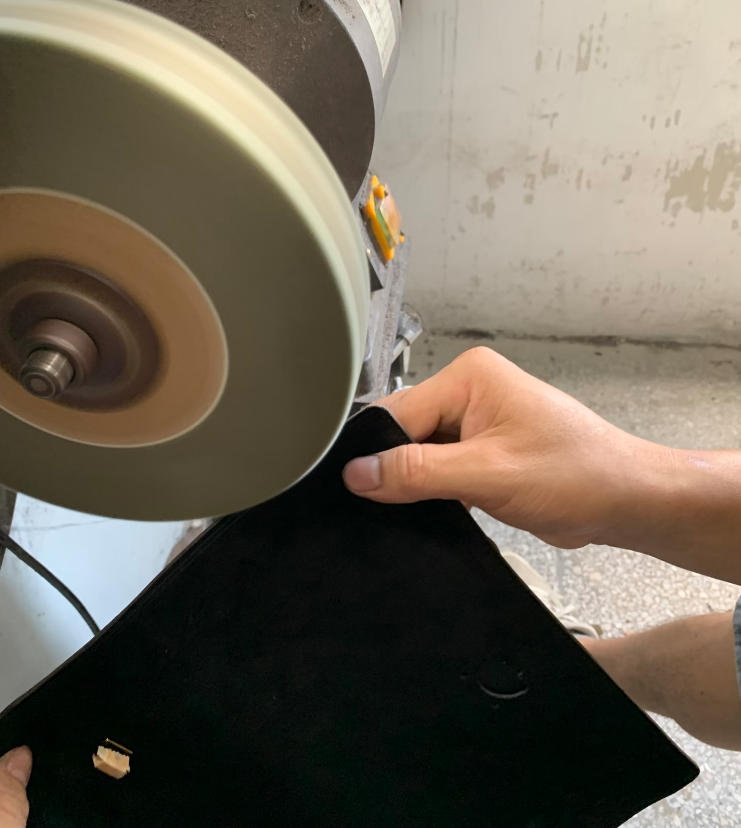
Much of the smoothness visible on a finished edge is created before the final coat is applied.
Between stages, sanding can be used to level the surface, remove small irregularities and prepare the next layer.
This is especially important around curved components and areas where several leather layers meet.
If the underlying edge is uneven, repeatedly covering it with more paint does not solve the real problem.
The Edge Should Follow the Design of the Bag
There is no rule that says edge paint must always disappear into the leather.
Tone-on-tone edge finishing creates a restrained appearance.
A contrasting edge can become part of the design language.
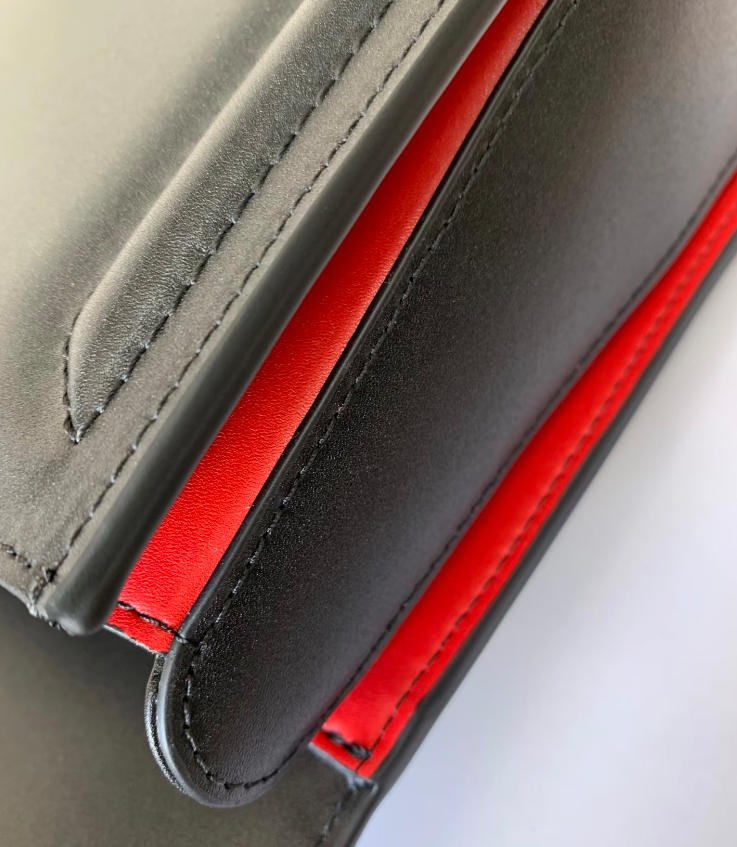
In the example below, the black exterior is combined with a strong red interior and matching edge detail.
In this case, the edge is not simply protecting the cut leather. It is visually connecting the exterior construction with the color inside the bag.
Different Leather Edges Need Different Treatment
A soft leather handle does not behave like a rigid flap.
A thick multilayer strap does not behave like a single-layer decorative panel.
Smooth leather, heavily grained leather and coated materials can also require different preparation.
That is why the edge specification needs to be developed together with the actual bag construction.
During sampling, we may adjust the preparation method, base treatment, color build or finishing process according to the component.
The objective is not to force every part of every bag through one standard recipe.
The objective is to achieve a controlled and repeatable edge that suits the product.
The Sample Has to Survive More Than a Photograph
A freshly painted edge can look good in a close-up photograph.
That is not the only thing that matters.
Before production, we also want to understand how the edge behaves when the component is handled, bent and assembled into the actual bag.
Areas such as handles, straps, flap corners and frequently opened sections deserve particular attention because they experience more movement than rigid decorative parts.
Once the leather, edge color, preparation method and finishing result are approved, they become part of the production specification.
The Goal Is Not One Perfect Edge
Making one beautiful sample is important.
For a handbag manufacturer, the more difficult job is producing the same edge consistently across the full order.
The color needs to remain consistent.
The corners need to remain clean.
The layer build needs to remain controlled.
And the finished parts still need to match the approved sample when they reach final assembly.
That is why we do not see edge paint as the last step before a bag is finished.
A well-finished edge is the result of material selection, preparation, application, sanding and production control working together.