Orciani Virgo bags turn the interaction between hand, material, and movement into the organizing idea of a new FW26-27 family. The current Virgo page presents 23 listings across Soft and Nabucco expressions, with small, midi, and shopping formats. From a B2B handbag factory perspective, the key question is how to specify a soft form across empty, carried, and loaded states without losing dimensional control.
Orciani Virgo bags begin with gesture, not a static outline
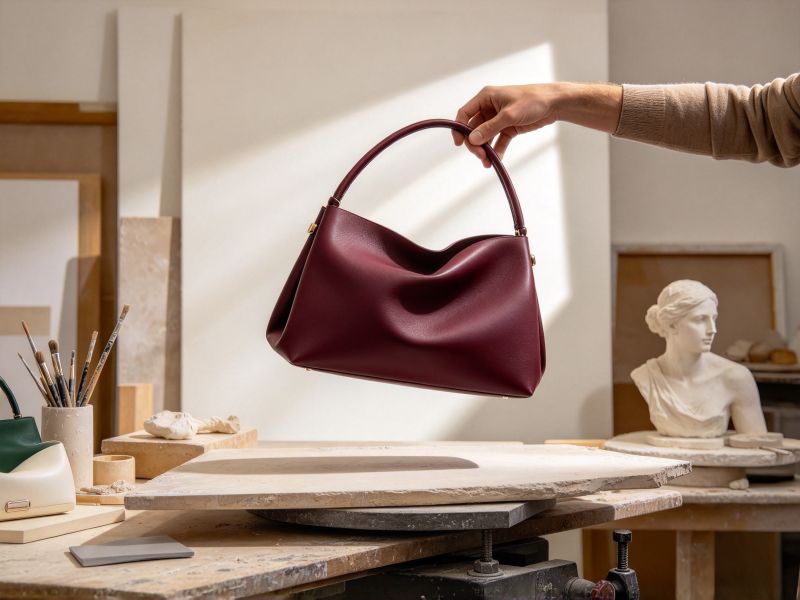
The official Virgo collection page uses the phrase “Shaped by gesture” and describes material responding to the hand, finding balance between tension and softness. It says the lines appear to emerge from movement itself. That language is unusually specific about how a bag should be perceived: character comes from a changing physical relationship rather than from a rigid front elevation.
For Orciani Virgo bags, gesture is supported by product evidence. The current range includes Soft Small, Soft Midi, Soft Shopping, Nabucco Small, and Nabucco Midi names. The reviewed product pages identify double top handles or double shoulder handles, zipped openings, internal pockets, hammered calf-leather surfaces, and removable straps on the small and midi handbag formats. The forms may look relaxed, but the functional anchors are clearly defined.
This distinction matters to an original product team. “Soft” should never mean unspecified. The buyer still needs target width, height, depth, opening behavior, handle position, strap path, pocket placement, base response, and an acceptable degree of collapse. Orciani Virgo bags provide a current public case for discussing those variables without turning a branded silhouette into a manufacturing reference.
| Current Virgo listing reviewed October 6, 2026 | Published dimensions | Organization and carry | Material and finish |
|---|---|---|---|
| Virgo Soft Small | 32 x 17 x 10 cm | Two inner pockets, one zipped; double top handle; adjustable removable strap | Hammered calf leather; palladium-finish hardware |
| Virgo Soft Midi | 40 x 22 x 12 cm | Three inner pockets, one zipped; double top handle; adjustable removable strap | Hammered calf leather; palladium-finish hardware |
| Virgo Soft Shopping | 38 x 28 x 14 cm | Three inner pockets, one zipped; double shoulder handle | Hammered calf leather; palladium-finish hardware |
| Virgo Nabucco Small | 32 x 17 x 10 cm | Two inner pockets, one zipped; double top handle; adjustable removable strap | Hammered nubuck calf leather; polished-gold hardware |
| Virgo Nabucco Midi | 40 x 22 x 12 cm | Three inner pockets, one zipped; double top handle; adjustable removable strap | Hammered nubuck calf leather; polished-gold hardware |
The table is a retail snapshot based on published product fields, not evidence of sales, permanent availability, factory tolerances, or confidential construction. Its value is comparative. Orciani Virgo bags hold small and midi dimensions steady across two materials, while the shopping format changes the carrying sentence and body proportion.
The family map concentrates on handbags
The current Orciani Virgo bags collection page displayed 23 listings at the research date. Its type filters showed 21 handbags and two shoulder bags. The material filters showed 12 nubuck, nine grained-leather, and two smooth-leather listings. Those counts describe the visible catalogue at one moment; they do not establish inventory depth, customer demand, or a permanent assortment.
The concentration still reveals the shape of the proposition. Orciani Virgo bags are not presented as a broad network of backpacks, crossbodies, clutches, and travel pieces. The family stays close to one hand-responsive body idea, then changes size, carry, material, and color. This makes silhouette behavior easier to compare because the collection does not ask one visual code to solve every category.
For Orciani Virgo bags, a focused family also raises the standard for differentiation between variants. If two products share a name and general attitude, the customer needs a clear reason to choose small, midi, or shopping. Published dimensions, pocket counts, removable straps, shoulder handles, material names, and care information become more important than an abstract promise of versatility.
Orciani Virgo bags therefore make a useful distinction between family recognition and SKU redundancy. Recognition can come from the way the body curves, folds, and meets the handles. Redundancy appears when two variants carry the same objects, sit the same way, and offer the same access without a meaningful material or occasion difference. A buyer should test that boundary before multiplying colors.
Small to midi changes proportion and organization
Within Orciani Virgo bags, the Virgo Soft Small product page lists a 32 cm width, 17 cm height, and 10 cm depth. It specifies two inner pockets, one zipped, plus a zipped main opening, double top handle, and adjustable removable strap. The Soft Midi page moves to 40 x 22 x 12 cm and three inner pockets, one zipped, while retaining the same published carry features.
That is not a simple width increase. The midi gains eight centimeters in width, five in height, and two in depth. Its organization count also changes. For Orciani Virgo bags, the larger body is given an additional interior decision point, which can help prevent contents from settling into one undifferentiated soft volume.
With Orciani Virgo bags, the customer’s hand experiences those changes before a measurement chart does. A wider opening can improve visibility, but a deeper load may pull the center downward and bring the top edges together. A longer bag can swing differently from the same strap. The handles may stand closer together when the body is empty and spread when loaded. Each state affects the apparent silhouette.
Photography should show that variability honestly. A front view filled with hidden supports can make Orciani Virgo bags look more rigid than they are. An empty view alone can exaggerate collapse. A useful product sequence includes empty, lightly loaded, normally loaded, hand-carried, and strap-carried images, all using the same camera height and background reference.
For an original collection, capacity should be approved through object sets. The small may be tested with phone, compact wallet, keys, eyewear, and a small pouch. The midi may add a larger notebook, compact umbrella, or bottle only if the opening and base support them. The purpose is not to assign Orciani’s use cases, but to demonstrate how size and organization must be verified together.
Shopping changes the carrying sentence
Within Orciani Virgo bags, the Virgo Soft Shopping page lists 38 x 28 x 14 cm, three inner pockets with one zipped, a zipped main opening, and double shoulder handles. Unlike the reviewed small and midi handbags, it does not list an adjustable removable strap. The product is designed around direct shoulder carry.
The shift is substantial. The shopping format is two centimeters narrower than the Soft Midi, yet six centimeters taller and two centimeters deeper. That gives Orciani Virgo bags another way to expand use: not by making every measurement larger, but by changing the vertical volume and carry relationship.
For Orciani Virgo bags, a taller soft body can accept longer objects and sit close under the arm, but it also creates a deeper visual field. Keys or a card case may disappear below other contents. The three interior pockets become part of the silhouette strategy because organization can reduce repeated digging that distorts the opening and lining. Pocket height should correspond to hand reach, not simply follow a standard pattern block.
Shoulder-handle clearance also needs testing with outerwear. If the drop is too short, the bag may be comfortable over a light shirt but difficult over a coat. If it is too long, a loaded soft body can move excessively. Orciani Virgo bags frame the shopping version as a distinct carrying proposition; an independent buyer should specify its own drop range, body contact, and loaded balance.
The shopping variant helps retailers explain occasion without inventing a lifestyle. Small and midi can move between top-handle and long-strap carrying because the removable strap is published. Shopping is built around shoulder access and a taller load. A comparison page should state those differences next to dimensions and pockets so customers do not have to infer them from photographs.
Soft and Nabucco hold one pattern in two material states
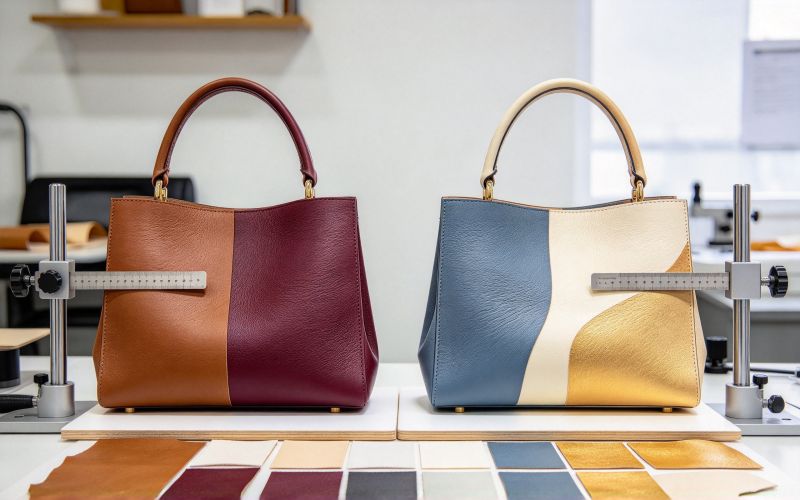
The reviewed Soft Small and Nabucco Small pages publish the same 32 x 17 x 10 cm dimensions, pocket count, zipped opening, double top handles, and removable strap. Soft is described as hammered leather with palladium-finish hardware. Nabucco is described as hammered nubuck leather with polished-gold hardware.
The reviewed Soft Midi and Nabucco Midi similarly share 40 x 22 x 12 cm dimensions, three internal pockets, double top handles, and removable straps. This creates a controlled public comparison inside Orciani Virgo bags: the nominal pattern envelope and function remain aligned while surface and hardware expression change.
Across Orciani Virgo bags, equal dimensions do not guarantee equal silhouette behavior. Nubuck temper, nap direction, thickness, backing, moisture response, and friction can alter drape and recovery. Hammered leather can also vary by article and finish. A softer surface may make folds more visible; a firmer backing may hold the opening differently. The product pages do not disclose those internal specifications, so no construction claim should be invented.
What can be transferred is the validation method. Build both material routes on the same approved pattern, then compare empty profile, opening width, loaded sag, handle-root distortion, strap-carried shape, pocket access, and recovery after unloading. If the behavior differs materially, Orciani Virgo bags remind buyers that one photograph and one tolerance sheet are not enough for every material.
Care communication should also match the surface. The reviewed product pages advise protection from direct light, heat, and rain, careful drying, light filling during storage, and avoiding heavy products that may affect shape. These are Orciani’s published instructions. An original brand must create care language from its own leather evidence, finishing route, testing, and packaging.
The empty-filled-carried state model
Soft-form development fails when approval is based on one perfectly arranged sample. Orciani Virgo bags suggest a better model because the brand language explicitly connects form with hand and movement. A buyer can define three mandatory states: empty on a surface, normally filled at rest, and carried with the intended load.
Empty state: record the natural opening, side folds, base contact, handle position, and whether the body stands, leans, or settles. Do not force the bag into an artificial outline. The empty state is important for retail shelves, unboxing, storage, and customer expectations.
Filled state: use a documented object set and total weight. Record width, height, depth, base deflection, pocket visibility, zip path, and whether hard objects telegraph through the leather. Orciani Virgo bags use internal pockets across every reviewed format, so the filled state should also show whether those pockets remain reachable.
Carried state: observe the bag by top handle, removable strap, or shoulder handles as applicable. Check how gravity redistributes volume, whether the opening twists, whether the handles pinch the top, and where the body contacts clothing. Film walking and turning because a still image cannot reveal swing or recovery.
Approval should define a permitted range rather than one exact wrinkle. Natural leather varies, and soft construction responds to loading. The specification can control seam alignment, reinforcement boundaries, critical dimensions, hardware position, and unacceptable collapse while allowing the intended material character to remain visible.
The Lounge and Inner Disorder provide two load scenarios
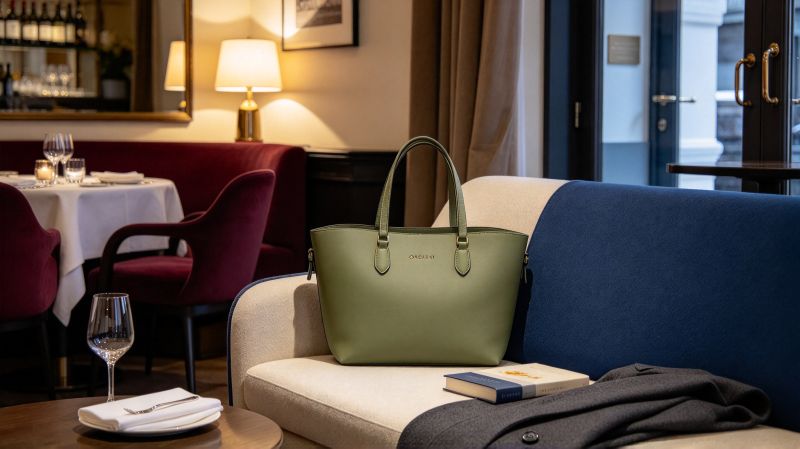
The FW26-27 “The Lounge” page describes a warm setting of friends, lingering dinner, conversation, gathering, and shared stories. Virgo Nabucco Small appears within that 54-item edit beside Venus, Sveva, Trinity, Her-O, belts, and accessories. The environment supports a composed social use case in which a handbag moves between hand, chair, table edge, and storage.
The “Inner Disorder” page takes a different position: a return to routine, motion, overflowing bags, and elegant spontaneous chaos. Virgo Nabucco Midi appears in that 67-item edit. It provides a more demanding load scenario in which contents, repeated opening, transit, and imperfect placement are part of the story.
These edits do not prove that every customer uses Orciani Virgo bags in those exact ways. They demonstrate two different contexts for the same new family: controlled social presence and active everyday disorder. A shape analysis becomes more credible when it accounts for both. The bag should look intentional in a quiet room and remain usable when ordinary life disrupts its ideal arrangement.
For merchandising, this creates a useful image sequence. One photograph can show the bag lightly filled and resting naturally in a social interior. Another can show the midi in motion with a realistic daily load. The contrast explains soft form better than two color-only catalogue images, while the product page still supplies the dimensions, pockets, fastening, materials, and carry features.
Color supports a material-led silhouette
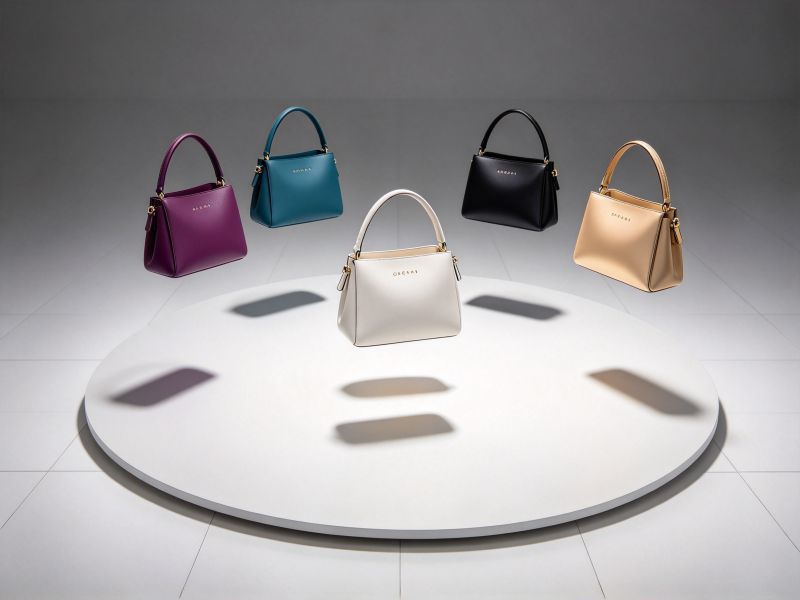
The Virgo page’s current color filters showed five black, five brown, five beige, three blue, three red, and two grey listings. These are catalogue counts, not demand rankings. They show that Orciani Virgo bags use a substantial neutral base while allowing blue and red to carry seasonal contrast.
Color behaves differently on hammered leather and nubuck. A dark smooth or hammered surface can emphasize reflected curves and edge lines. Nubuck disperses light through its nap, making folds appear softer and creating directional variation when touched. The same named color may therefore need different photography, tolerance language, and care expectations by material.
A range review should approve color on a complete moving sample, not only on a flat swatch. Observe the bag empty, loaded, and compressed; check rub-off, nap tracking, edge contrast, lining visibility, and hardware interaction. Orciani Virgo bags make color part of the silhouette experience because the surface changes how tension and softness are seen.
How to brief an original soft-form silhouette
The following five-step method converts the public shape logic of Orciani Virgo bags into an independent development process. It does not reproduce Orciani’s silhouettes, handle architecture, material finishes, hardware, proportions, or brand-identifying expression.
- Define the three silhouette states. Draw and describe the intended empty, normally filled, and carried profiles, including the object set, load, carry mode, and acceptable movement.
- Lock the functional anchors. Specify opening length, base zone, handle roots, strap attachments, pocket positions, and closure alignment before tuning soft folds around them.
- Map material and reinforcement zones. Record leather article, thickness range, temper, backing, lining, seam construction, and the transition between supported and free-moving panels.
- Prototype under gravity. Measure the full-scale sample on a surface, suspended from each handle or strap, loaded, compressed, and unloaded; film motion and record recovery time.
- Approve a behavior range. Retain signed samples and images that show acceptable variation, plus measurable rejection limits for twist, collapse, puckering, misalignment, and permanent deformation.
Buyers can use our custom handbag sampling process to evaluate original material and silhouette states before multiplying sizes. The custom leather bag development scope can then connect approved behavior to buyer-owned patterns, specifications, and production controls.
Factory evidence for motion-shaped handbags
A factory inspection needs consistent fill conditions. Create a reusable load kit with photographed placement, total weight, and clear orientation. Measure the sample before loading, after a stated dwell time, while suspended, immediately after unloading, and after recovery. This turns “soft but not shapeless” into observable evidence.
Handle roots and zips are critical anchors. A soft body may magnify small asymmetries because the panels move around fixed components. Check the left and right handle angles, reinforcement visibility, zip-wave behavior, top-edge twist, and whether the strap attachment pulls the opening off center. Test each material route separately.
Packaging should support recovery without forcing a rigid silhouette. Excess stuffing can stretch panels and distort handles; too little support can create deep transit creases. Specify tissue quantity, fold locations, hardware isolation, dust-bag size, carton orientation, and recovery inspection after simulated transport.
Our private label bag manufacturing service can review buyer-owned state definitions, while the handbag factory capabilities page provides broader production context. Original design records, material evidence, and clear ownership are required; Orciani Virgo bags are an educational market reference, not a product template.

Buyer questions about Orciani Virgo bags
What is the clearest shape lesson from Orciani Virgo bags?
The family presents soft form as a response to hand, material, and movement while still publishing dimensions, pockets, closures, and carry features. A successful soft bag needs both expressive behavior and controlled functional anchors.
How do Virgo Soft Small and Soft Midi differ?
The reviewed Small is listed at 32 x 17 x 10 cm with two inner pockets. The Midi is 40 x 22 x 12 cm with three inner pockets. Both list zipped openings, double top handles, adjustable removable straps, hammered leather, and palladium-finish hardware.
What makes the Shopping format a separate silhouette role?
It is listed at 38 x 28 x 14 cm with double shoulder handles. Compared with the Midi, it is slightly narrower but taller and deeper, and the reviewed page does not list the removable long strap used on Small and Midi.
Why must an OEM factory test every leather route?
Equal pattern dimensions can behave differently when temper, thickness, nap, backing, friction, lining, and reinforcement change. Each route needs its own empty, loaded, carried, and recovery evidence.
What should a private-label soft-bag brief contain?
Include three-state silhouette references, object set, load, dimensions, opening, handles, straps, pocket map, material and reinforcement zones, recovery limits, acceptable variation, photography conditions, care, and packaging.
From hand gesture to a controlled soft-form family
Orciani Virgo bags give FW26-27 softness a focused product architecture. Small and Midi maintain top handles and removable straps while changing dimensions and organization. Shopping moves toward a taller shoulder-carried volume. Soft and Nabucco preserve published pattern envelopes across hammered leather and nubuck, allowing material character to change how the same nominal form is perceived.
The campaign context adds two credible states: the composed intimacy of The Lounge and the active everyday load of Inner Disorder. The transferable principle is not an Orciani outline or finish. It is the discipline of defining how an original bag should look and function empty, filled, carried, compressed, and recovered.
To develop an original motion-shaped handbag family, send your RFQ with intended silhouette states, object sets, load targets, carry modes, dimensions, material specifications, reinforcement zones, acceptable variation, testing needs, quantities, and ownership documentation. Orciani Virgo bags are most useful when they prompt a measurable behavior brief rather than a visual imitation.
This article is an independent educational analysis. It is not affiliated with Orciani. We do not produce counterfeit or replica goods, and we do not reproduce protected logos, trademarks, patterns, proprietary designs, hardware, silhouettes, or brand-identifying elements.