Boyy Poster Sac presents a timely case of a brand idea moving from graphic gesture into a soft handbag experience. Published in late September 2026, the current product family pairs nappa lambskin, expandable gussets, a drawstring closure, an embossed mark, four color choices and a US$425 price in BOYY’s default online market. For private-label and OEM teams, the useful factory question is how an owned visual language can guide original form, material and customer interaction without reproducing another brand’s protected expression.
The Boyy Poster Sac evidence snapshot
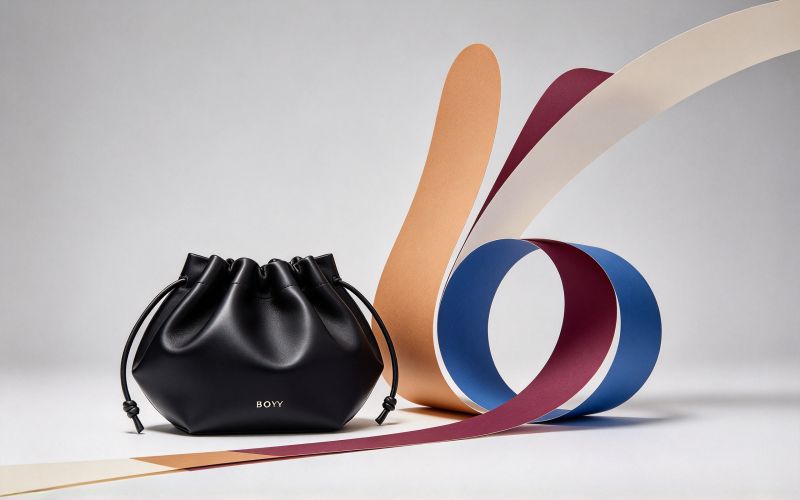
The public facts are concise. The official Boyy Poster Sac product page identifies nappa lambskin, expandable gussets, a drawstring closure and an embossed logo. Its description explicitly calls the product a continuation of BOYY’s journey with the free-form spirit of its hand-scripted logo. The current product sitemap shows Black, Cinnamon, Nile and Red Wine pages, each published on September 30, 2026. The default US storefront data viewed on October 12 lists each at US$425.
Those observations establish seven useful hotspots: a recent launch date, a soft lambskin body, changing side volume, a pull-to-close interaction, a quiet embossed identifier, a four-color edit and an accessible position within the brand’s current handbag offer. They do not reveal sales, demand, production volume, supplier relationships or confidential design intent. Availability and prices can change, so readers should verify the live pages before making a purchase or market decision.
The Boyy Poster Sac is therefore best read as a tightly documented brand-positioning case, not as a general quality review. The official wording supplies an unusually direct bridge between a two-dimensional brand gesture and a three-dimensional product. Material, construction and merchandising can then be examined as supporting evidence, while any deeper interpretation remains clearly labeled as analysis.
From a handwritten gesture to a handbag proposition
A hand-drawn line has rhythm, pressure, acceleration, pause and irregularity. A soft bag has folds, tension, compression, expansion and recovery. The official description of the Boyy Poster Sac connects these territories through the phrase “free-form spirit,” while the bag’s lambskin, gussets and drawstring give that idea physical behavior. This does not mean that the product literally traces a letter or that every fold was derived from typography. It means the public brand narrative invites customers to understand freedom of line through freedom of form.
That distinction matters. A logo applied to a standard pouch is surface branding. A brand-to-form proposition asks whether the material response, opening action, volume and photography reinforce the same character as the owned graphic identity. The Boyy Poster Sac combines an embossed identifier with a body that appears capable of changing state. The mark names the source; the pliable object makes the story experiential.
For an independent label, the transferable lesson is a method rather than an appearance. Start with a brand behavior that the buyer owns: precision, interruption, rhythm, compression, layering, balance or another defensible idea. Translate that behavior into a product brief, then design original geometry and construction around it. Do not use BOYY’s lettering, bag outline, proportion, gusset arrangement, closure placement or combined visual expression as a template.
Nappa lambskin turns graphic freedom into tactile freedom
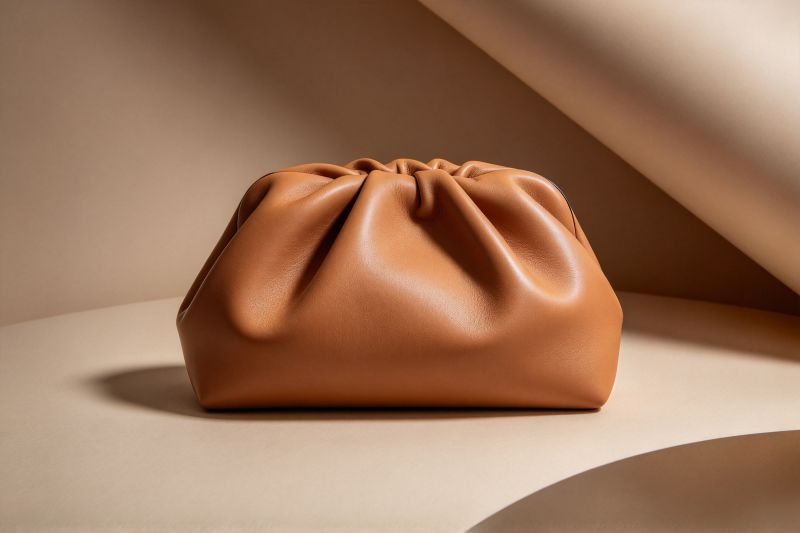
The official page specifies nappa lambskin. In the Boyy Poster Sac story, that material matters because a free-form proposition needs visible response. A very rigid shell would hold one fixed contour; soft lambskin can gather near a drawstring, round around contents and settle differently after use. The material gives light a moving surface and lets the user perceive volume through touch.
Softness, however, is not automatically expressive or durable. Lambskin thickness, temper, grain consistency, backing, lining choice, seam allowance, skiving and edge treatment determine whether folds look intentional. A material can feel luxurious in a flat swatch yet become weak around a drawstring channel or collapse unevenly at an expandable side. Public product language does not disclose BOYY’s specifications, so no hidden construction should be inferred.
The Boyy Poster Sac also shows why brand positioning and material approval cannot be separated. If the concept promises free-form ease, a batch that is too stiff changes the customer’s reading even when color and pattern are correct. If the leather is excessively loose, the bag may lose containment or show uncontrolled distortion. A development team needs a tactile range, not only a color standard.
For an original product, approve material in at least four conditions: flat, gathered, lightly loaded and recovered after unloading. Observe highlight width, fold radius, surface marking and return behavior. The goal is not to make an imitation of the Boyy Poster Sac; it is to prove that a buyer-owned concept remains consistent as the leather changes shape.
Expandable gussets make identity visible in profile
An expandable gusset is both a capacity device and a silhouette device. Closed or lightly loaded, it can keep the side compact. As contents increase, it allows the body to occupy more depth. The Boyy Poster Sac uses this public feature to support a product that is not visually frozen. Its side profile becomes part of the brand story because expansion makes the free-form claim observable.
The important design decision is where expansion begins and stops. Gusset depth, fold direction, seam curvature, top opening and base behavior must be coordinated. If the side opens more quickly than the base, the bag can become top-heavy. If the lining resists movement, the outer shell may wrinkle without producing useful interior volume. If the drawstring closes against a fully expanded side, the mouth may bunch unpredictably.
For customers, these mechanics should be legible without technical language. The product page can show the Boyy Poster Sac relaxed, opened and gently filled from consistent angles. That sequence would explain why the side construction exists. A single polished front image might communicate color and logo, but it cannot prove how the volume changes.
For designers, a profile drawing should include more than maximum depth. Record the rest state, useful working state and intended maximum state. Define whether folds should remain symmetrical, whether the base can widen and how the opening behaves under load. Expansion is valuable only when the extra space remains accessible and the bag can still be carried as intended.

The drawstring turns closure into an expressive action
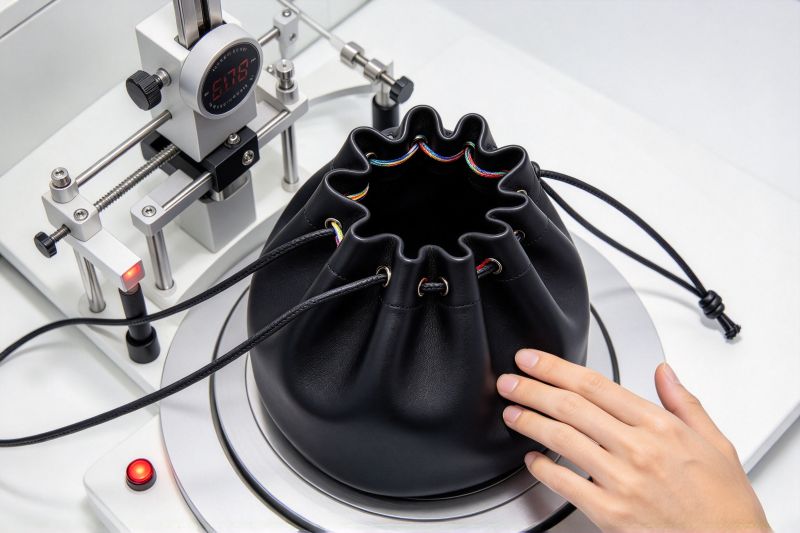
A zipper generally follows a fixed track; a drawstring reshapes the edge it closes. Pulling the cord gathers material, changes the opening diameter and redistributes folds. On the Boyy Poster Sac, the closure therefore contributes to the free-form proposition. The customer does not merely access the bag and hide a mechanism; the closing gesture actively creates the top line.
That expressive action still has to work. Cord diameter, surface friction, channel width, exit angle, stopper or knot logic, end treatment and hand clearance all affect confidence. The closure should not require excessive force, abrade the leather, loosen unexpectedly or leave long ends that interfere with carry. The official short description confirms a drawstring but does not publish this engineering detail.
The Boyy Poster Sac invites a useful content question: what does the opening look like before, during and after the pull? Showing that sequence can reduce uncertainty about access and security. It can also reveal whether the embossed logo remains visible and whether the side expansion changes when the mouth is gathered. A product story becomes more credible when the customer sees the interaction that supports the concept.
An original handbag can use a completely different closure and still translate an owned brand gesture. A folded flap might express interruption; a curved zip might express continuity; a tensioned tab might express compression. The principle is to make customer action consistent with brand character, then test it for usability. The Boyy Poster Sac is evidence for that connection, not a closure blueprint.
Four colors give the same free-form idea four voices
Black, Cinnamon, Nile and Red Wine form the visible color edit for the Boyy Poster Sac in the current sitemap. Because the form and listed price remain constant, color carries much of the merchandising difference. Black can emphasize outline and shadow. Cinnamon can make the softness feel warmer and more tactile. Nile can move the pouch toward a cooler, less expected register. Red Wine can deepen the sense of evening or autumn richness without changing the stated construction.
These are visual interpretations, not claims about BOYY’s target customer or sales results. The valuable point is that folds amplify color. A flat panel may appear relatively uniform, while gathered nappa creates highlights, valleys and tonal shifts. The Boyy Poster Sac therefore asks color approval to account for three-dimensional light, not only a flat swatch.
Four variants are also easy to compare online. The retailer can keep the same product explanation and allow color to change the emotional entry point. Unlike a collection that changes hardware, material and size at once, the Boyy Poster Sac color group holds the functional proposition steady. That makes the brand-to-form idea easier to recognize across the family.
For an original range, photograph trial colors in the actual folded and gathered sample. Review them under daylight, warm retail light and the intended e-commerce setup. Check edge paint, lining, cord, thread and embossed mark together. If one color hides the form language or makes surface variation look defective, it may not belong in the launch even when the swatch is attractive.
A US$425 handbag can act as a brand-language entry point
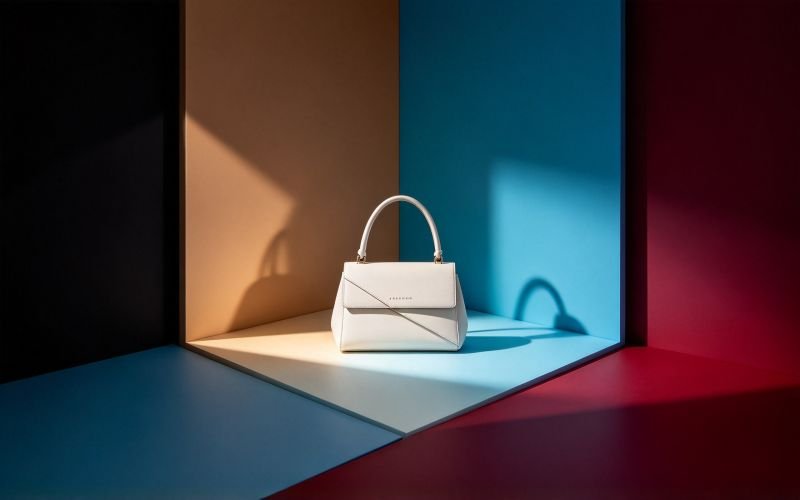
The default BOYY storefront response viewed on October 12, 2026 lists each Boyy Poster Sac color at US$425. Price and market settings can change, and this public value does not reveal margin, cost or demand. Within a luxury discovery journey, however, the listed level can place a new customer closer to the brand’s current language than larger leather handbags priced above US$1,000 in the same storefront.
That positioning makes clarity especially important. A customer encountering the brand through the Boyy Poster Sac should be able to understand what is distinctive beyond a logo: supple material, expanding side volume, a drawstring-created top line and a compact color story. If those qualities are invisible online, the product may read as a generic pouch. Brand-positioning value depends on explaining the designed relationship among them.
The launch also sits inside a broader 2026 fashion context without needing to claim direct trend causation. Vogue’s July 2026 report on Fall/Winter 2026 handbag trends describes a “New Clutch Era” in which supple, pillowy pouches extend beyond evening use. The Boyy Poster Sac is not cited in that report, and its drawstring format is not identical to a clutch. The source simply shows that soft, compressible hand-carried forms are part of a current market conversation.
For brand managers, the commercial lesson is to separate relevance from imitation. A current soft-bag climate can make consumers more receptive to tactile volume, but an owned story still needs independent evidence. The Boyy Poster Sac uses BOYY’s public hand-scripted narrative as that evidence. Another label should begin with its own identity and decide whether softness genuinely serves it.
The embossed mark should support, not replace, the form
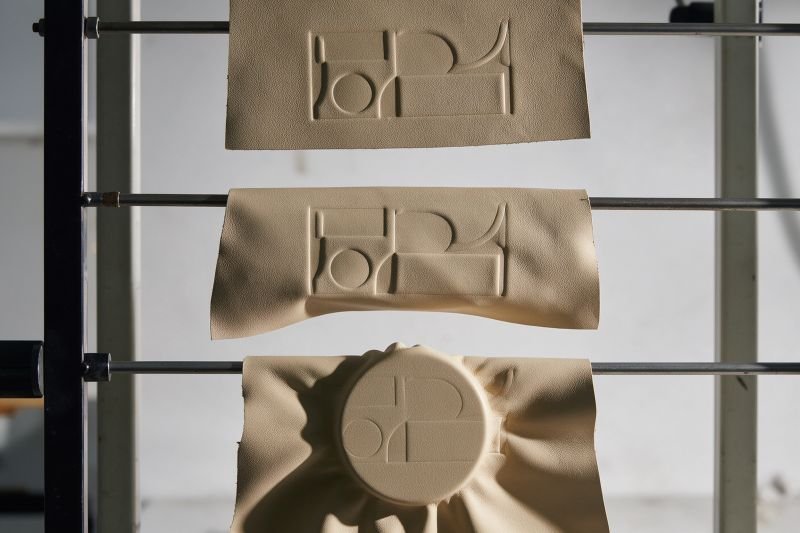
The official description notes an embossed logo. Embossing can keep branding tactile and relatively integrated compared with a large applied plate. On the Boyy Poster Sac, the mark belongs to the same material surface that folds and expands, which helps the graphic-to-object story remain cohesive. Its legal ownership and exact execution are brand-specific and must not be reproduced.
Emboss depth, heat, dwell time, pressure, grain, backing and panel position affect legibility. Soft lambskin can rebound or distort, especially near a flexible gusset or gathered opening. A test that looks clean on a reinforced coupon may fail on the finished bag. Approval should therefore include the actual panel, actual material batch and all relevant load states.
The Boyy Poster Sac also suggests a hierarchy: the mark identifies, while the bag behavior communicates. If an independent label removes its logo and the product loses every trace of the intended brand character, the translation is too superficial. Original seams, proportion, opening behavior, material response and color should carry part of the identity.
An original-design workshop for private label teams
The safest use of the Boyy Poster Sac case is to study the logic and discard the branded expression. A private label bag manufacturing service should receive buyer-owned inputs, not requests to reproduce BOYY’s logo, silhouette, gussets, drawstring placement or overall visual combination. The following workshop turns an owned brand gesture into measurable original-development choices.
- Name the owned behavior. Select one quality already supported by the buyer’s identity, such as balance, interruption, layering, precision or rhythm. Document the rights and source material behind it, then express the quality in plain language without referencing another handbag.
- Translate behavior into product actions. Decide how the bag should open, close, expand, rest, recover and carry. Generate several unrelated original silhouettes so the concept does not collapse into one borrowed market example.
- Assign material evidence. Choose leather or textile behavior that makes the concept visible. Define temper, thickness range, backing, lining and surface standards, then review prototypes flat, gathered, loaded and recovered.
- Separate identity layers. Map which cues come from form, construction, interaction, color and owned branding. Remove any protected or confusingly similar cue and confirm that the remaining system still communicates the intended character.
- Validate the customer reading. Show neutral reviewers the product and retail content without explaining the concept first. Record the words they use, their opening errors and the evidence they need. Revise the product or story when the intended behavior is not apparent.
A custom handbag brief can attach this workshop output to a use case, object list, target price, market, forecast volume and test plan. During the custom handbag sampling process, the team can evaluate whether the original concept survives material substitution, construction refinement and real use. Brand language becomes a practical acceptance criterion rather than a mood-board slogan.
Retail content must reveal the translation
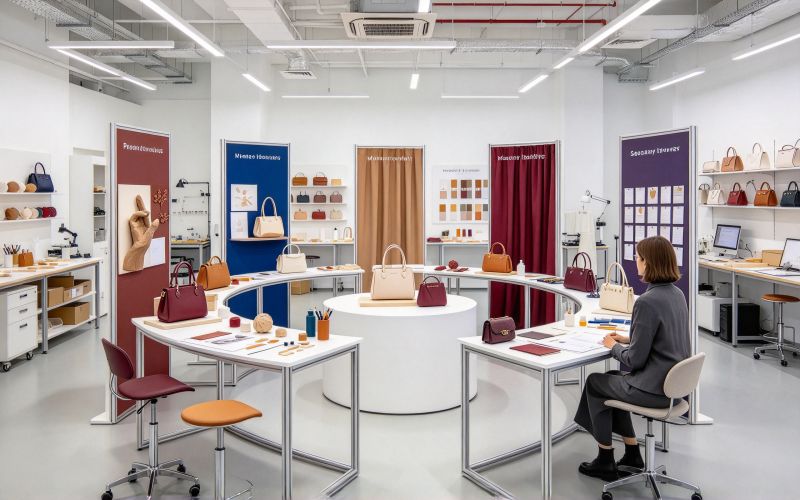
A brand-to-form story needs more than a campaign still. For the Boyy Poster Sac, a useful content sequence would begin with the resting silhouette, move to hand contact and drawstring action, show the gussets under a realistic load, then return to the carried form. Close material and emboss views can support the sequence. This would demonstrate the public product claims without exposing confidential construction.
Color pages should preserve comparable camera distance and lighting, but nappa’s tonal movement also deserves one color-specific close view. Black may need edge lighting to reveal folds; Nile may need careful color management; Cinnamon and Red Wine may require controls that prevent warmth from shifting. Consistency makes comparison possible, while one tailored asset helps each Boyy Poster Sac color communicate its own voice.
Measurement and object-fit information would strengthen confidence because an expandable description does not define useful capacity. Brands should publish only verified dimensions and photographed object sets. Avoid implying that flexible volume is unlimited. The drawstring opening, lining and access path can impose practical boundaries even when the side gussets grow.
For wholesale, place the brand idea and the buying facts on separate but connected pages. The first explains why the object belongs to the label. The second states materials, dimensions, closure, colors, wholesale terms and delivery information. The Boyy Poster Sac case is strongest when narrative and product evidence reinforce each other rather than compete.
What Boyy Poster Sac adds to the 2026 handbag conversation
The Boyy Poster Sac brings a specific proposition to the current soft-bag landscape: a recent nappa lambskin pouch with expandable sides and a drawstring, presented by BOYY as an extension of its hand-scripted, free-form identity. The four-color edit keeps that message concentrated. The US$425 listing gives customers a relatively direct route into the story, while the embossed mark confirms brand authorship on the material surface.
Its value for B2B readers is not a recipe for another drawstring pouch. It is evidence that brand positioning can be built through coordinated product behavior. Form expands, leather responds, the closure gathers, color reshapes the folds and the mark stays integrated. The Boyy Poster Sac feels more conceptually complete when those elements are read together.
Teams developing an original soft handbag can review our handbag factory capabilities and send an RFQ with owned brand principles, original sketches, material behavior, opening sequence, target use and measurable tests. The development goal should be a legally distinct product whose form proves the buyer’s identity, not a substitute for the Boyy Poster Sac or any other branded item.
Disclaimer: This article is an independent educational analysis. It is not affiliated with Boyy. We do not produce counterfeit or replica goods, and we do not reproduce protected logos, trademarks, patterns, proprietary designs, hardware, silhouettes, or brand-identifying elements.